From inspiration to idea
There are so many ways that writers take inspiration from the world around them. Snippets of conversation overheard at a train station (to the lady at Liverpool Lime Street who started a conversation with “Did you hear what our Sharon did?”, no… I didn’t hear, and it haunts me to this day); imaginations can be sparked by a piece of music or a TV show, by a text message sent to you by mistake from a number you don’t recognise, and the songs of Dolly Parton (see Down from Dover – the Little Sparrow album version if you can find it -, Daddy Come and Get Me, Daddy’s Moonshine Still, and Joshua, and gather your own evidence).
It’s everywhere. The possibilities of stories are all around us. I could sit and write a short story called What Our Sharon Did if I was so inclined. In fact, I might do just that someday.
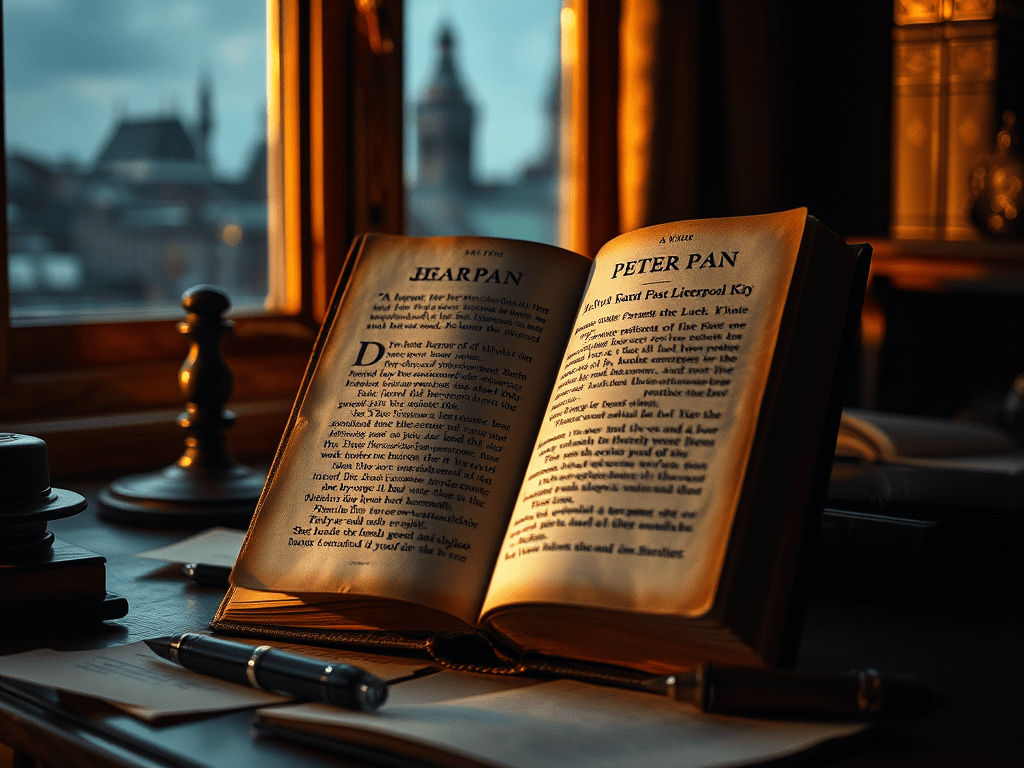
The idea for my debut novel, Black Water Rising, a police procedural thriller came to me whilst reading a gorgeous leatherbound edition of JM Barrie’s “Peter Pan”. And that’s the thing about ideas – they can come at unexpected times, in peculiar ways, and can evolve into something you never expected.
I have always written with an eye to the macabre, at home mostly in all of that gorgeous grey space that lies between the white and the black. There’s so much you can do there, so much you can find; and that’s where the idea for Black Water Rising came from. Here’s how it went from the haunting tale of an ageless boy to the grim first instalment of a Liverpool-set crime series.
The birds were flown
Having grown up, like so many of us, with Disney’s movies, books, and toys, I thought I was familiar with the story of Peter Pan. But I was wrong. The novel has this haunting vibe right throughout that really captured my imagination. When researching more about it, I found out that Barrie was writing about the death of his older brother, who passed away after being knocked down by a friend whilst ice skating, fracturing his skull. Barrie’s mother sank into a deep depression, and it’s said that Barrie spent his childhood vying for his mother’s attention whilst trying to come to terms with his own grief after his brother’s death. It’s reported that he even went into his mother’s room dressed in David’s (his brother), clothes.
I was struck by the tragedy in that. The trauma that his mother was clearly in the centre of, a trauma that Barrie himself shared with her. Slapped in the face with the imagery of it: of kids flying through the nighttime sky at midnight, the time between yesterday and tomorrow, onward to a place called Neverland with a boy who will never grow up.
Haunting.
In the book, there is one line in particular which really got to me, something that I didn’t remember being explored in the Disney movie. It made me put the book down and get to work on planning – and, in truth, I’ve never picked up that book since.
“Mr. and Mrs. Darling and Nana rushed into the nursery too late. The birds were flown.”
- From Peter Pan, JM Barrie. 1904.
Do you see it? It may not be as earth-shattering to you as it was to me. The parents knew that the kids were gone. I remember sitting there reading that line over and over and thinking: well what now?
I sat with the idea of it for days. What did the parents tell their friends? Their family? The school? Their neighbours? Do they go to the police? Do they try to find the kids themselves? If so, how?
There could have been answers in the rest of the book, but I was gone. The birds in those pages were flown, but my mind had stayed with their parents, with the agony of their children’s absence, of wondering whether they’ll ever come back.
Then, a woman formed in my mind – I’ll speak more about character development in future posts, so I won’t bog us down here – and I knew she was the person through whom I’d tell my story of lost children, of pain and trauma, of sinking low and attempting to overcome it.
I set out writing, without a clear plan I might add, and drafted and redrafted, crafting this absolutely gorgeous horror narrative, set in my own Merseyside version of Stephen King’s Maine. There were maps, an extra slash of Merseyside carved into the existing space, a crescent moon shape to give me more room to add in my own things. Old churches abandoned by the Church, myths and folklore about witches and Vikings and dead lovers, woods haunted by memories, all ready for future novels.
Drafting crime
I was doing my Master of the Arts degree then at Liverpool John Moores University (LJMU), and during one of our many workshop sessions, my tutor – Cathy Cole – said in her lovely Australian accent: “This should be a crime novel.” Not what you want to here when you’re over 20,000 words into a manuscript, is it?
Sometimes, you have to know when to accept feedback, when to try the idea out, and when to completely ignore it. For example, if someone told you a character who came from a working class background and worked hard to become a therapist wasn’t realistic because “therapy is a middle class occupation”, you know exactly what to do with that feedback, don’t you? Put it in the bin with the rest of the rubbish. But, if you never take feedback and think you have it all right, I can promise you now that your work is more than likely shite. No creative piece is ever written in silo, and it never should be. Writing is a collaborative process, and if you just want someone to tell you “oh, this is so good”, then ask your mum to offer you feedback, or other friends who don’t know how to write, instead of other writers. You’ll be trapped in an echo chamber of your own ego until you realise you need to improve your work to get anyway.
It took me almost three pages to thank all of the people who have been involved in helping me write Black Water Rising, and if you take a look at any novel’s acknowledgements pages, you’ll see the same.
In Cathy’s case, she was right. I had the mum’s investigation into her kid’s disappearance happening alongside the police one. Why not merge them? What would happen then? What if the mum was a police detective? It opened up a whole new world to me that I’d never really considered before.
I kept in mind that one line from Peter Pan, “The birds were flown”, and held on to how that made me feel; the trauma of Barrie and his mother, and realised that what I was actually writing about was my own Post Traumatic Stress Disorder (PTSD). Though not the result of the same experience as Barrie and his mother, my PTSD was still there in my writing and it was obvious. I ran with it, and decided that each of my first three books would explore a different aspect of trauma.
In conclusion, I think we sometimes get too bogged down with the notion of having to have an idea. Something original and solid and fully formed, but that’s not the case, and it adds so much pressure to the creative process. My advice is to give yourself a break, watch some trash TV, go for a walk, listen to Dolly Parton’s back catalogue, and let the idea find you.
I promise you, it’ll come when you least expect it. People say that about so much, don’t they? In this case, I think it’s true. The key is to keep your mind open, and always, always, always question: what if?
What if the police accused the Darlings of killing Wendy, Michael, and John? What would happen if you merged The Wonderful Wizard of Oz with The Real Housewives of Beverly Hills (you’d have more than two wicked witches, I suppose)? What if aliens landed on our planet, opened the door of their spaceship and we saw ourselves instead of grey-skinned, big-eyed creatures?
And what did our Sharon do?
Sean Watkin
 Sean Watkin
Leave a comment