The Fox Vale
By Sean Watkin
Author note: This short story was an attempt for Sean to capture the atmosphere of his debut novel, Black Water Rising (then titled The Mud of the Mersey), when the idea changed from a horror novel to crime fiction.
It was entered into a short story competition judged by Val McDermid in 2020. He didn’t hear back about the competition, but Black Water Rising was shortlisted for the McDermid Debut Award in 2025.
The rubber grumbled and dragged. The left rear tyre needed changing. He had to stop here at the side of the road next to the wooden gate and the Private Road sign. There were two things to do: change the tyre and put the boy somewhere. He didn’t have time to change the tyre and get to the reservoir. This would have to do.
He rolled down the window and stared out. The animal-shit stink of farmland. In the barns and stables beyond the fields many eyes were shut tight. They slept in their hay and filth and in the morning, they would be tended to lovingly by farmers whose wives made breakfast: bacon, sausage, eggs, and black pudding. The boy would change all of that. A disruptor to the usual humdrum of life in the Fox Vale. His heart was falling, an anvil dropped from a building into the pit of his swarming, gurgling stomach.
The air straddled the autumnal gap between cold and freezing. Fog squatted over the empty fields. It looks like the sky has already begun to fall, he thought.
Past the fields and barn of what was now the Williams’ Farm, a light comes on in the upstairs of the farmhouse. Instinctively, he turned off the engine and headlights. It took some time to adjust to the new quiet and in a tree somewhere nearby, an owl tooted. A witness.
He stepped out of the car. The gravel crunched under his heavy black boots. He leant against the dirty Ford Transit and looked up. The sky was clear, the stars burned bright. He didn’t know their names, but his mum had known them by heart. Out here, on cloudless nights, you could see shooting stars. She’d brought him once. Before she’d left. The moon was half full, swelling each night; there would be enough natural light to work. He shifted his attention to the house and thought he could make out a silhouette in the window. Then the light was gone.
He pulled open the back doors of the van. Under a white corrugated panel was a spare tyre and jack and beyond that, in the black of the van’s catafalque were the boy’s feet. A shaft of moonlight made the skin appear like glass. He wanted to brush his hand over the white skin; to see how cold it felt now after these first few hours. There was a need in him to take the boy home and build a fire, to make him warm again. As though his tears and his hands could heat the boy back to life.
The tyre first.
He raised the van slightly on the wobbly jack. He worried it might give way, it looked so flimsy. The wheel nuts were unrelenting. He wasn’t a typically strong man but some things he could get done. He rested his cramping hands, rubbed hard at the palms and fingers. He didn’t want to do this. He rubbed at his eyes. It felt like there were shards of glass under his eye lids, and they streamed now. Moans came from the depths of his guts. Animal-like. His stomach lurched and he turned away from the van to vomit in the gravel.
He took control of his ragged breath and gripped the spider wrench, grunted against the strain of effort until one nut finally gave way. The others came away more easily and the tyre pulled off the hub. He set it down against the van’s side panel and eased on the spare tyre.
He had never done this type of work before but remembered watching his dad do it as a kid. ‘every man should learn how to change at least three things in their life.’ He’d spluttered between drags on a cig, hammered hard at the tyre of some old boxy car they’d had in the 80s. ‘I picked car tyres, light bulbs, and my undies.’ He’d laughed and relished the good mood his father was in. They were rare as hen’s teeth. The only time his father was in a good mood was Sunday evenings after bath time. He never bathed alone.
The tyre was fixed tight, so he lowered the van back to the ground. He collected the wrench, flat tyre, and jack, placed them back under the panel and climbed into the van.
The boy’s skin was icy to touch. That shocked him. This work was new to him, too. It felt smooth as it had done in life. This skin didn’t belong to the boy anymore. The boy was gone. He realised that when he looked into the wide-open blue eyes, his pupils like the dark twins of stars in the ancient sky – distant and unmoving. These were not just the eyes of the dead. He’d seen that far-off glare in the eyes of many children since he was young himself. He saw them in the mirror sometimes.
The films and TV series don’t prepare you for the truth of a dead body. They showed you parts, just snatches. The forensic clues that would inevitably bring about the perpetrator’s unravelling. His unveiling. There was always a motive. A purpose. The smooth talking investigator who was either top of their game or plagued by alcoholism would easily unpick the mystery within one to two hours. But this wasn’t supposed to be. The boy should never have been like this. The truth was terrible. Daunting. A weight whose ghost fixed itself to his back and would stay there forever even as the boy rotted.
A small wash bag was tucked away at the back of the van, next to the wiring of the rear lights. Inside was an unopened packet containing a single pair of latex gloves, a spray bottle containing a clear liquid, and a dish cloth. He took each item out and tucked them into the free pockets of his khaki cargo trousers.
He snapped on the latex gloves, eyes darting after each particle of falling powder from their inside. Some on the boy’s hairless leg, and more on the floor of the van. He made a mental note. The rug he’d brought was already underneath the boy’s backside. He just needed to place him into position and then role it around him like a shroud. He hauled the boy to the end of the van and lifted him up onto his shoulder. The boy felt awkward to carry, unexpectedly heavy.
The wooden gate that closed the private road off from the main stretch was rickety and choked with green moss; its joints and hinges were rusty and crumbled. The Private Road sign barely clung to the gate with a single nail. He pushed hard against the gate, put his weight into it. It dragged against the mud and stopped. Refused to move any more.
Fuck.
There was now a narrow gap between the rotten gate and the fence post. He didn’t think he’d fit through; he’d put weight on recently. He squeezed through the gap and didn’t notice the boy’s scalp rip against a loose bolt.
The private road was no more than a dirt track. His boots sank deep into the mud like it was snow and he felt the weight of every step; each time he placed a foot, the tearing feeling of losing something, of leaving something behind. The police would have a good starting point in their forensic investigation. He knew they’d be able to identify the make of his boots, the size of his feet, and even the fact that his left foot sank slightly deeper. A knee injury from when he was ten years old.
It had happened on Christmas morning. Mum was gone by then. He woke up next to Dad, sore. There was blood on the sheets even after all those years. He sneaked downstairs and went to the Christmas tree first, excited for whatever Father Christmas may have left behind. There was nothing there. There’s something unhappy about an unlit tree; the lights were dull pieces of coloured glass set among tinsel and home-made decorations. In the space between midnight and sunrise everything looks blue.
He pulled back the curtains and found that everything outside was covered in white. Snow still fell from the thick banks of grey clouds like feathers from a burst pillow. His breath steamed the window. He put his hand on it and looked at the lines in the print left behind. The back door was unlocked. He didn’t step out straight away. The snow was untouched. Not even the tiny feet of reindeer. He must have been a very bad boy. That’s what Dad would say when he got up later. He’d be punished again, then held and squeezed and loved like he was made of gold.
Nobody had walked outside yet. This was new ground. Finally, he stepped out and he felt like the first man on a new world. The snow pricked his feet like freezing needles. The fence at the back of the garden was indistinguishable from the ground and the sky until he got closer. He looked back at the open back door and the black kitchen, it sucked at the cold winter air like a mouth breathing in. His footprints in the snow all led here. They ventured nowhere else but the fence. He began to climb. Each time he placed his foot or hand, it felt like he was touching glass. He reached the top and peered over at the snow-covered 4×4, the small courtyard that glowed orange under the security lights. He flung over his leg but missed, cracked his ankle against the wood and fell backward, twisted in the air. Landed on his knee and cried out. Everything had turned white.
The barn was barely visible through the sheet of fog over the Fox Vale. He could hear the grunt of pigs and the desperate clucks of chickens. They know I’m coming.
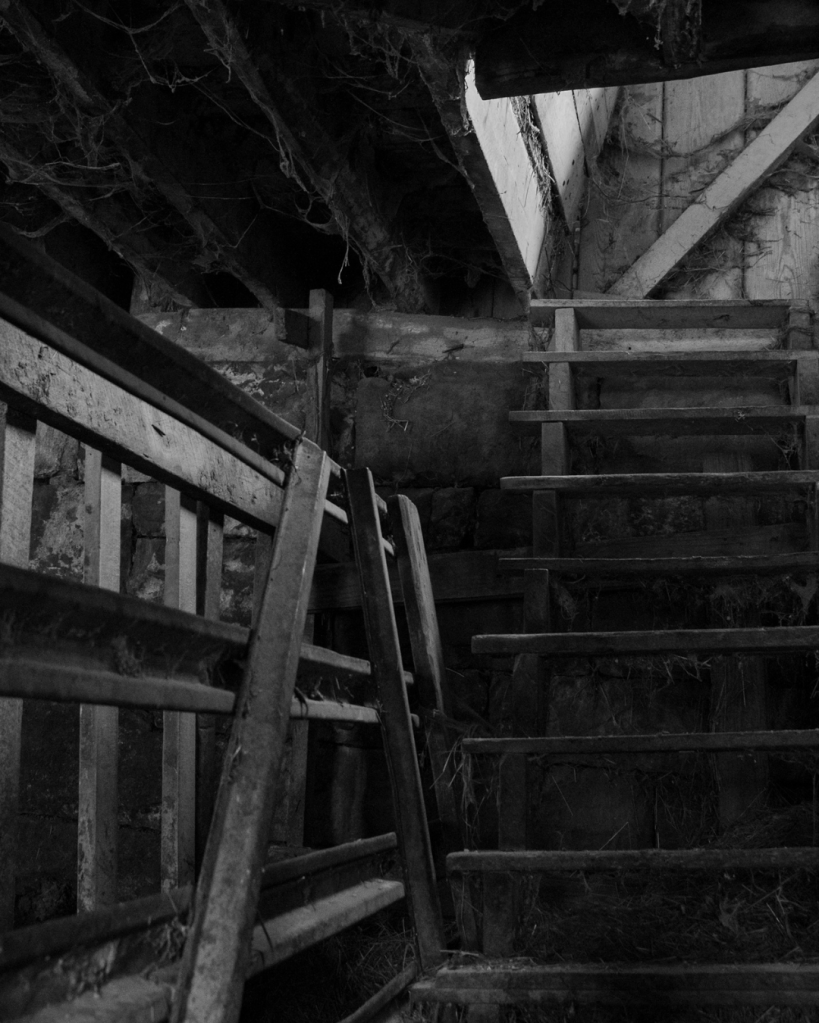
The barn door had been painted. It wasn’t flaky or covered in moss like the gate or the fences. He imagined the farmer decided to treat it before autumn fell and it falls hard in the Fox Vale. The hinges made no sound as he pushed through the door. In the shadow recesses of the barn, behind wooden fences, fat hairy pigs watched. The air was thick with the earthy sweet stink of shit. Their tiny eyes didn’t leave him as he placed the boy on the top of two bales of hay.
He unrolled the rug and slid it out from under the boy. He’s shocked at how heavy the boy is. He flips the boy over, sprays everywhere and cleans off the liquid with the cloth. Turning the boy back over, he noticed the tear at the hairline.
‘No!’ His skin burns like it’s on fire, and his face and chest flush red. ‘I’m sorry.’ He beat at the side of his head and cried; hot, heavy sobs. Like someone whose skin is stung and scratched at in the thick undergrowth of fresh grief. He leant down and kissed the boy’s forehead. Cold. It reminded him of the window that Christmas morning. He wiped away his kiss with the bleached cloth.
He hadn’t meant for this to happen. he loved the boy. He was family, after all and his sister didn’t listen to the horrible things people say about him. The whispers in the street, over garden fences, and in the living room after Dad’s funeral. ‘It’s so sad for him,’ Aunt Liza had said. ‘He was all his father had.’
You don’t know half of it, he’d thought. Not half of it all. He’d heard it said that history repeats itself and he wondered now as he sits looking down at the boy’s small body, whether all fathers loved their sons in this way. Whether it was a son’s duty to be whatever the father needs. Whether a punch bag after coming home from The Queen’s Arms or someone to climb into bed with in the middle of the night. History had repeated itself.
Outside, somewhere beyond the dark barn, a scream. His breath caught and as he dried his eyes on the sleeve of his black hoody, he listened. It came again. Someone had seen him, found the van, saw him coming here with the boy.
He left the barn and closed the door behind him as quietly as he could, though it creaked and moaned. The scream came again, short and in quick succession. Out there, between the fields of crop, tiny eyes shone white. Foxes. Relief surged through his muscles and they relaxed.
The farmhouse was in dark. Whoever was awake before had returned to their nice warm bed. He wondered whether they slept in his old bedroom, and whether they had kids of their own. How did they love them? Did they love them? It would be Christmas in a few weeks and he wondered how those kids, warm and rosy-cheeked, how they’d bound down the stairs to a lit Christmas tree with presents all around. Which they’d open first, which they’d fight over, and which they’d love the most. He thought that the only time their father’s hands would touch them was to pat their backs and say, ‘Well done’, or to hug them and say ‘I love you’.
The normal love. The real love. Not like the love his father had for him. His father would hold him by his waist and say, ‘Hold still love, it’ll hurt less.’
 Sean Watkin